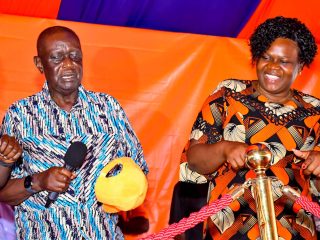
President Ruto’s full Labour Day speech
We gather here today at Chavakali Boys High School, Vihiga County, with a deep sense of gratitude and honour to the men and women who keep the engine of our economy in motion. The people without whose sacrifice, sweat, and toil our nation would grind to a halt. We are here to celebrate the hands that mould our economy, the ingenious minds that keep innovating, and the resilient spirit that dares to imagine a transformed and better Kenya, every day.
These are our hardworking, diligent, and ever-hopeful workforce. We are here to pay tribute to their resilience, to their discipline, their resourcefulness, and their indomitable belief in Kenya’s transformation. To every worker across Kenya, I say today, with profound appreciation, that your effort is the foundation of our progress; your well-being is the true measure of the state of our nation; and your dignity is a reflection Fellow workers and citizens,
Today is equally a historic moment. For the first time in the 61 years of celebrating Labour Day in independent Kenya, these national celebrations are being held outside the capital city Nairobi.
This is a significant and transformative step, a reflection of our commitment to reach, recognise, and directly involve workers across the country, including those in our rural economies, whose contribution is no less vital to our nation’s progress.
To the great people of Vihiga County, I extend my deepest gratitude for the warmth of your welcome and the generosity of your hospitality. Ladies and gentlemen,
From a historical perspective, Labour Day did not begin as a celebration, but as a struggle, a struggle for the dignity of workers, for fair working conditions, and for just remuneration. That struggle, born in the 19th Century at the height of the Industrial Revolution, remains as relevant today as it was then.
Yet, in our time, we are faced with an equally pressing challenge – the urgent task of creating meaningful employment opportunities for our people, especially our youth. Each year, no fewer than 800,000 Kenyans enter the labour market, while the formal sector is able to absorb just about 100,000.
From the very outset, this administration has pursued a deliberate and decisive three-pronged strategy to expand opportunity for all: Kazi kwa Ground, Kazi Mtandaoni, and Kazi Majuu.
In all that we do – in every policy we advance and every programme we implement – one objective remains constant: To unlock opportunity, to empower our people, and to ensure that every Kenyan has a fair chance to work, to earn, and to fulfil their potential.
Through targeted support for Micro, Small and Medium Enterprises (MSMEs), the Affordable Housing Programme, the expansion of the digital economy, strategic investments in agriculture and value addition, strengthened education and skills training, the facilitation of overseas employment, and sustained infrastructure development, we are systematically laying the foundation for inclusive growth.
Inclusive growth and opportunity, ladies and gentlemen, are anchored in the strength of the economy. The true measure of resilience is not found in a single statistic, but in the soundness of its fundamentals and the confidence it inspires. By every meaningful indicator, Kenya’s economy remains steady, robust, and resilient.
Our GDP growth has held firm at 4.6%, even in the face of global uncertainty and external disruptions. Inflation, at 5.6% in April, remains within a manageable range, particularly in the context of prevailing global pressures, while our foreign exchange reserves, standing at $13.3 billion, provide close to six months of import cover, safeguarding our macro-economic stability.
The Kenya shilling has stabilised at KSh129 to the dollar for over two years now, reflecting renewed market confidence. At the same time, key sectors, from agriculture and construction to financial services, continue to drive broad-based expansion, ensuring that growth is not only sustained, but shared. Sustained inflows from diaspora remittances, alongside continued investor confidence, further affirm that Kenya remains a trusted, competitive, and forward-looking destination.
But most importantly, this resilience is being felt where it matters most – in the lives of our people. Across the country, jobs are being created in their thousands, a clear testament to the capacity of our economy to absorb labour and expand opportunity.
It is for this reason that I commend the Central Organisation of Trade Unions for the choice of this year’s Labour Day theme, “We Support the Northern Link: Accelerating Trade through the Rironi-Malaba Highway Transformation”.
The theme reflects a clear alignment with the government’s strategic focus on infrastructure as a key driver of economic transformation, regional integration, and job creation.
The Rironi-Mau Summit Road is not merely transforming infrastructure; it is reshaping livelihoods. As a vital corridor, it strengthens regional connectivity, streamlines the movement of goods and people, and unlocks new economic opportunities across our nation.
Western Kenya is a major beneficiary of this road expansion. The traffic nightmare that has long confronted those travelling to this region during peak periods will soon be a thing of the past, replaced by smoother, faster, and more reliable connectivity.
This will happen as soon as next year.
Along the route, this road is unlocking employment for contractors, suppliers, and communities while opening doors for trade, tourism, and investment. At least 10,000 new jobs will be created through this project alone.
Additionally, we recently launched the extension of the Standard Gauge Railway (SGR) from Naivasha to Kisumu, a 262km corridor that will connect the industrial hub of Nairobi to the rich agricultural heartlands of Western and Rift Valley regions, including Narok, Bomet, Kericho, Nyamira, Kisumu, Vihiga and Busia.
We have also broken ground on the 107km Kisumu-Malaba section of the SGR, completing a nearly 1,000km rail corridor from Mombasa to Malaba, and establishing a critical link to the Malaba-Kampala line. Along this corridor, from Mombasa to Malaba, we will catalyse the development of industrial parks, logistics hubs, and commercial centres.
The expansion of the Rironi-Mau Summit Road, which will ultimately extend to the Malaba border, together with the onward extension of the SGR to Malaba, represents a new generation of future-shaping infrastructure. These are not just transport projects; they are strategic national investments designed to unlock the full economic potential of our regions and connect Kenya more deeply to the East African corridor.
But their greatest impact will be felt in the lives of ordinary Kenyans. These projects will generate jobs, stimulate enterprise, and attract investment along the corridor, ranging from logistics and manufacturing to trade and services. They will create new centres of growth, expand incomes, and lay the foundation for shared prosperity.
Fellow citizens.
Another key pillar of our transformative infrastructure agenda is housing. Through the Affordable Housing Programme, we are not simply building homes; we are reshaping the face of urban development across our nation and turning the dream of home ownership into a living reality for thousands of Kenyan workers.
Today, more than 273,000 affordable housing units are under construction across the country, and over 9,000 have already been completed and handed over to deserving families.
Here in Vihiga County, for example, six affordable housing projects are either underway or under procurement, delivering 3,720 housing units with an investment of approximately KSh7.5 billion. At the same time, student accommodation projects, both ongoing and in the pipeline, will provide 4,540 bed spaces backed by a further investment of over KSh1.9 billion.
Meanwhile, 10 market projects are under implementation, with six more in the planning stage. These will deliver 3,470 market stalls currently under construction and an additional 600 in the pipeline, supported by investments of about KSh1.5 billion for ongoing works and KSh475 million for planned developments.
Taken together, the government’s cumulative investment in Vihiga County – in housing and market infrastructure – now exceeds KSh15 billion.
This scale of investment and opportunity is unfolding in each of our 47 counties. Never in the history of our nation has every corner of Kenya witnessed such breadth and depth of development.
Critically, this progress is being driven not by unsustainable borrowing, but by the resources generated through the hard work, enterprise, and sacrifice of patriotic Kenyan workers. It is your effort, your productivity, and your belief in this country that is financing and delivering this transformation.
And on this Labour Day, I say thank you to every Kenyan worker for not only believing in our country, but for actively building it, sustaining it, and shaping its future.
But beyond the walls we raise, and the roofs we build, lies an even greater story, the story of work, the story of dignity, and the story of opportunity. The Affordable Housing Programme has already created more than 640,000 jobs, and we are firmly on course to reach our target of one million jobs under this transformative national project.
Our young people are at the heart of this progress, with nearly half of all workers on these sites under the age of 35. Women hold up to 30% of these jobs, while persons living with disabilities account for 5% of the workforce, which is well above industry norms and a clear statement of our commitment to inclusion.
Importantly, up to 60% of the workforce on each site comes from the host county, ensuring that opportunity is not imported, but grown locally so that wages circulate within communities, businesses thrive, and development is truly felt by the people.
The transformation we are witnessing in the housing sector is not occurring in isolation; it reflects a broader, deliberate shift taking place across every sector of our economy.
It is the same transformation we see in the education sector, where, in just three years, we have recruited over 120,000 teachers, built 23,000 classrooms, and are delivering 1,600 new laboratories, particularly in underserved and rural areas. At the same time, we have introduced a student-centred funding model that places resources where they belong – with the learner.
It is the same recalibration that is underway in agriculture, where we have established a verified digital register of over 7.2 million farmers. By doing so, we have eliminated middlemen and dismantled cartels, ensuring that farmers directly benefit from government support and interventions, including access to subsidised fertiliser, boosting productivity, strengthening food security, and restoring fairness to the sector.
It is the same spirit of transformation driving the MSME sector. Through targeted initiatives such as NYOTA, we have brought over 121,800 young entrepreneurs into a structured business pipeline, equipping them not just to seek employment, but to create it. And some 800,000 Kenyans, who were previously locked out of the mainstream financial system, have now rebuilt their credit profiles and can access higher microloans of up to KSh150,000 through the Bridge facility under the Hustler Fund – opening the door to opportunity, enterprise, and financial inclusion.
It is the same transformation we see in the overseas employment programme where, through coordinated leadership, deliberate policy, and strong global partnerships, we are opening structured, safe, and dignified pathways for Kenyan workers to access opportunities abroad.
Supported by a Global Labour Market Strategy, bilateral agreements with key international partners, and flagship initiatives such as Mkulima Majuu, Mhandisi Majuu, Dereva Majuu, Muuguzi Majuu, and Mwalimu Majuu, over 580,000 Kenyans have already secured employment beyond our borders, with their rights protected and their futures expanded.
It is the same expansion we are witnessing in the health sector where, through bold reform and decisive action, we have expanded health insurance coverage from fewer than 8 million Kenyans just three years ago to nearly 30.8 million today under the Social Health Authority, bringing close to 65% of our population into the safety of care compared to just 16% under the defunct National Hospital Insurance Fund.
This is not a marginal improvement; it is a fundamental shift, one that is restoring dignity in times of illness, extending protection to millions of families, and accelerating our journey towards truly universal health coverage.
Fellow citizens.
That is why I have absolute confidence in the state of our nation and its trajectory. Do not be distracted by the noise. Do not be swayed by screaming headlines. Or by the chorus of alarm from those who trade in the currency of fear.
They can see what is happening because they live here, as we all do. But they cannot bring themselves to acknowledge the change, the progress, and the transformation, because to do so would strip meaning from the only narrative they perpetuate.
Kenya is transforming. Kenya is changing right before our eyes. The noise may command attention, but it cannot, and it will never, change reality. Because the true story of a nation is not told in sponsored headlines, it is written in the daily actions of citizens like the 30.8 million Kenyans who have registered with SHA, and the thousands who continue to do so daily.
Ladies and gentlemen.
Let me thank the Secretary General of COTU (K), Brother Francis Atwoli, for his unwavering advocacy for the Kenyan worker, and his consistent support for government programmes such as the Affordable Housing Programme. The government values this partnership, and I want to take this opportunity to address some of the concerns raised on behalf of organised labour.
On the matter of the deposit for affordable housing units, I am pleased to confirm that the commitment I made to COTU at State House last year has been delivered. The deposit required of all applicants for allocation of an affordable housing unit now stands at 5%, down from 10%.
This applies to every salaried Kenyan, and the reduction has already been codified in our allocation framework. This deposit has been codified in the Affordable Housing Regulations, which were passed in 2025 and have since been applied.
Second, on the engagement of workers in the allocation of housing units. Every salaried worker is, by law, eligible and qualified for an affordable housing unit. We only have one rule: One ID, One home. This means you can only benefit once from the programme.
The pathway to ownership is straightforward: Register on the Boma Yangu platform, select a preferred unit, complete the application, and you will be considered for allocation. Many of the Kenyans who have been allocated homes are themselves trade union members, civil servants, teachers, nurses, and disciplined officers.
The system does not ask whether an applicant carries a union card before allocating a home; it asks only whether they are a Kenyan worker who has stepped forward to claim what is theirs.
I therefore invite COTU (K) and every affiliate union to actively mobilise their members to register on Boma Yangu and apply. The State Department for Housing and Urban Development stands ready to work with COTU on a structured outreach campaign to guide every interested worker through the application process. Where there are specific cases of workers who have applied and not been served, bring them forward, and we will resolve them.
On the recognition of construction work as a skilled profession. I agree entirely, and I am pleased to note that the framework the Secretary-General is calling for is already in place and is delivering results.
The National Industrial Training Authority certifies trade qualifications across the construction sector. The National Construction Authority accredits and registers contractors and skilled workers. And through our Recognition of Prior Learning programme, which we are running directly in the Affordable Housing Programme, we are formally certifying artisans whose skills were learned on the job.
To date, more than 2,000 artisans have been certified through this programme, including 180 women. These certifications open the door to formal contracts, higher wages, and the international labour markets the secretary-general has rightly identified.
On the rights of workers enshrined in Article 41 of our Constitution – the right to fair labour practices, to organise, and to bargain collectively – let me reiterate that these rights are not negotiable, and this government will defend them without compromise.
Every worker enjoys the full protection of our labour laws. And in close partnership with COTU, the Federation of Kenya Employers, and the Ministry of Labour, we will ensure that these protections are not merely written in law, but consistently upheld and rigorously enforced in practice.
Regarding healthcare, it is equally important to acknowledge that the concerns we have recently seen, from teachers and other public servants, arise not from a rejection of SHA, but from transitional operational challenges.
In the early stages, measures introduced to safeguard the financial sustainability of the fund, such as temporary outpatient caps, created unintended friction. In some cases, this led to unacceptable practices by a few facilities, including demands for co-payments or even outright denial of services.
However, let me assure all workers, especially teachers and public officials, that those challenges are being decisively addressed. The government has already withdrawn the restrictive tariff mechanisms and initiated a structured, nationwide engagement with healthcare providers.
These negotiations will culminate in updated agreements that guarantee a seamless, zero co-payment, “walk-in, walk-out” experience for all public officers.
I am equally pleased to inform our workers that, following my directive to ratify the International Labour Organisation (ILO) Convention No. 189 on Decent Work for Domestic Workers and ILO Convention No. 190 on the Elimination of Violence and Harassment in the World of Work, the National Labour Board has completed the ratification process.
The Ministry of Labour is now in the final stages of preparing the necessary instruments for submission to Cabinet in accordance with the Treaty Making and Ratification Act and other applicable legal frameworks.
Finally, in recognition of the sacrifice, resilience, and immense contribution of our workers to the growth and stability of our economy, I am pleased to announce a 12% increase in general wages and a 15% increase in agricultural wages.
To all Kenyan workers, Happy Labour Day. May we continue building this nation together for this and future generations, as we strive to transform Kenya into a developed economy within our lifetime. I thank you.

Shows
See AllAM Live
AM Live is NTV's morning current affairs show that sets the agenda for the day with insightful panels every weekday.
Business Redefined
Business Redefined is Kenya’s premier thought leadership platform for unpacking matters regarding economic and finance policy as well demystifying complex developments in the region’s capital markets.
Comedies
A collection of our premium content. Diam curabitur vehicula A collection of our premium content. Diam curabitur vehicula
Creatives & Coins Podcast
A podcast that dives deep into the vibrant and rapidly evolving digital creative economy in Kenya. This show explores the lives, challenges, and triumphs of individuals who are successfully navigating the gig and creative economies. From digital artists and content creators to freelance writers and tech entrepreneurs, we spotlight the voices that are shaping the future of work in Kenya.
Documentaries
A collection of our premium content. Diam curabitur vehicula A collection of our premium content. Diam curabitur vehicula
Entertainment
A collection of our premium content. Diam curabitur vehicula A collection of our premium content. Diam curabitur vehicula
Fixing The Nation
Fixing the Nation is a bold and groundbreaking show that will take an unflinching look at challenges facing the Kenyan society and the solutions that can move us forward. It is anchored by respected journalists Eric Lattif, Janet Mbugua, and Mariam Bishar. Podcast created by: Nation FM
Fixing the Nation
Fixing the Nation is a bold and groundbreaking show that will take an unflinching look at challenges facing the Kenyan society and the solutions that can move us forward. It is anchored by respected journalists Eric Lattif, Janet Mbugua, and Mariam Bishar
Full Episodes
A collection of our premium content. Diam curabitur vehicula A collection of our premium content. Diam curabitur vehicula
Gumzo La Sato
Gumzo La Sato is a live social issues show that aims to create awareness about issues affecting the larger society. The discussions range from Parenting, Marital bliss and struggles, Oppression, violence, and all matters of the Heart.
Health Diary
Health Diary is a weekly show that highlights different types of diseases/conditions and seeks ways to prevent, treat/manage them. The show debunks this through real life stories and also feature specialists in different fields, to offer medical advice on the same.
Letter To My Younger Self
Letter To My Younger Self is a podcast where guests get to write a letter to their younger self, from which Maxine formulates questions to ask them during the hour-long show.
Lunch N Rants
Take a minute outside your schedule to have a good laugh and conversations that resonate with you. Welcome to Lunch N Rant podcast where we talk about anything and everything life.
Nation Reports
Nation Reports is a weekly podcast offers an opportunity for listeners to interact with various reporters and journey with them as they unravel the biggest most emotive stories.
One Health Lens Podcast
Discussing health matters and human stories from Kenya and across Africa. We talk big picture from people to policy, ecosystems, and everything in between. Follow us on LinkedIn: https://www.linkedin.com/company/onehealthlens
Paradise Lost
Paradise Lost peeks through the story of Louis Otieno, the times, and everything in between.
Primetime
A collection of our premium content. Diam curabitur vehicula A collection of our premium content. Diam curabitur vehicula
Speaking of GEN Z
Speaking of Gen Z brings you entertaining but meaningful conversations about a generation that is trying to navigate through adulthood. Join hosts Michelle, Jackie and Esther as they unravel all things Gen Z.
Sport On
Sport-On is a 30-minute sports magazine show on NTV and 3 hours on NATION FM. The show seeks to give the sports “fanatics” and “funatics” comprehensive and in-depth coverage of sports both locally and internationally.
Tech-over
The extent of technological growth is beyond mere acknowledgment; it has seamlessly integrated into our daily existence. A few years ago, the notion of paying electricity bills through mobile money or recharging with 'tokens' in Kenya seemed inconceivable. Online product sales were considered distant, and artificial intelligence is rapidly reshaping various facets of our lives. Amidst these technological leaps, those with a solid understanding of tech can navigate challenges, seize opportunities, and build a sustainable livelihood. Tech over Show aims to be the platform facilitating discussions among thought leaders, innovators, tech companies, and the government, addressing challenges and opportunities in Kenya's thriving tech industry.
Thamani
Thamani is a business show which is dedicated to emerging issues regarding micro, small and medium size businesses.
The Politalk podcast
This is The Politalk podcast. Here we look into the ins and outs of everything Kenyan politics. We pull no punches and have no reason to sugarcoat anything that matters to Kenyans.
The Trend
A two-hour-long live show that airs on Fridays. The show focuses on what is current in the entertainment industry, controversial and popular across all media platforms targeting those aged between 25 and 35 years.
The trend podcast
The trend podcast highlights and captures the best of banter from #TTTT segment that airs every Friday on NTV. It's the TTTT EXTRA
The Wicked Edition
The Wicked Edition with Dr. King’ori seeks to address serious issues through humour and relatable wit. It is a two-part half hour show filmed in front of a live audience
Trending
A collection of our premium content. Diam curabitur vehicula A collection of our premium content. Diam curabitur vehicula
Twende
Twende is a travel show that highlights beautiful, unique, diverse locations, people, and cultures. The show offers fresh perspectives on familiar locations and memorable experiences in new ones.
Unscripted
This Saturday evening lifestyle show lets viewers share their stories and life experiences as openly & honestly for the purpose of shifting the culture of silence.
VIP Access
VIP ACCESS is Anyiko Owoko’s YouTube and podcast show on Music and Culture dedicated to promoting Africa’s most promising talent and creatives. This podcast grants you VIP access into timeless interviews while providing a platform for rising as well as established artists across the continent. Since launching in 2018, Anyiko has interviewed over 70 African music stars.
WADR
This weekly news show aims to have all sides of debate but not be constrained by it, listen to main voices in the contest but not allow them to hold the viewers hostage, entertain debate but allow push back with all due respect.
When death do us part
In this podcast, three widowers openly speak about the process of grief, how they found themselves exposed to the emotional turmoil of losing their wives, and how society still does not know how to deal with them.
Your World
Your World is a health, wellness and variety show. It provides a platform for audiences and experts to share their experiences on how to improve or manage health issues, across Kenya and the Africa region.